How lucky, how cruel To know truly I had this time with you The flowers bloomed And the sun rose high, and I remember you That all I ever had to do, was smile and say I love you Days pass on and I, go on without you The deepness that we knew, the treasures, the moments Of the everyday, here and there Our memories shared, the laughter that lives forever
How bitter, how sweet To know I must carry this on, for you To dream again and again, that you never left That all was never put to rest “I am fine, I am here.” A wish that it was all misconstrued To feel you once again, and wake up to know it’s all gone
How lucky, how cruel For everyone that misses you, every story shared Every precious item in my hand, I feel you, I cry for you All the words and beauty you shared with me Every true smile you gave to me, the years I kept you
How gracious, how adrift For all the years I’ll never know, all those plans lost and we can’t go To watch others achieve all the landmarks and congratulations Ones you deserved and wished for For all my baby’s smiles and touches I can’t share with you All those questions and conversations we can’t have Those moments I still need you
How lucky, how cruel That you were bowed, but never broken, the strength that kept me through We stood against the world, just us two Fighting for each other, living for each other We had just gained so much, lost so much together We were about to have it all, new adventures, freedom, time, means All wiped away by loss and disease
How wondrous, how terrible To live and remember without you But there is life within everything, it’s all confetti she said You’ll dance around me, shining in all we do Telling me not to linger here, for life is out there
The feeling of rain on the skin Barely felt but a caress it is The slightest warmth But a passing damp upon the flesh A graze from hand or cloth, and gone
Certainly that’s the feel of my gaze A shift in sight, an embrace lingered long a moment A smile while your words flow to my ears Sitting beside you, an honor I dare not keep The sight of you, I’ll simply never hold too long
It is a hollow rain desire, Felt deep in my soul screaming I am an ugly problem All muck and messed up leaves And for my love an unknown An issue felt and refuted What response is given to this?
Lost in the welling of light drifts Most likely as cold as the snow But felt like the twinge of nerves under the skin Ever heating Ever hotter Till the burning breaks through Till I tear my mind open Bleeding and repulsive If I hold the blood to you Will you then know the truth?
What dark matter could it give? Even if you understood The blood would simply seep away One can’t heal the undesired Expectant to take the sacrifice It simply can’t be done The flesh falls away, through fingers twisted Retched as the offal drips through Wasted on the shining ground
It’s easy to say you love another Beautiful, full of endowment, verdant Green hills, set upon with sunshine Giving, lovely, vibrant of life and wonder So much more than dry and somber, drab grey Who could see the obsidian in the blinding light of Spring?
If only I could feel your world for a moment Feel your drum beat under my skin Dance along with you in the heat of the smoke Leave you knowing love cannot be confined Let you know there’s no choice to be made Simply let the love fall upon you Far more than the hollow drops in the rain Far more the swelling of a river Washing you in all the love you could desire
The other day I had the privilege of listening in on a podcast being recorded by elders in my community. During this podcast episode, death preparation was brought up, originally in a spiritual context but the practical side could not be avoided. The truth is, no matter what your particular situation or beliefs, the fact that there will be a corpse left after you are gone cannot be avoided. What may be less obvious, or more so ignored is that we also have a duty to that corpse just as much as we have a duty to ourselves.
This responsibility may not seem important to our living selves, and may not seem to matter about our bodies when we are dead, but it can matter to the people who will guide your corpse to its final destination. Here is where personal belief might matter in this context. Understanding this delineation between your death and your duty to your own death can come in many forms, and can be a long topic in and of itself. For many, the phrase, “it won’t matter anymore because I’ll be dead.” is often the end of the conversation. For others, especially those who understand death positivity, there can be a lot more nuance. As a quick note on terminology, death positivity, and the death positive movement on a social scale is a social and philosophical movement that encourages people to speak openly about death, dying, and corpses. The movement seeks to eliminate the silence around death-related topics, decrease anxiety surrounding death, and encourage more diversity in end of life care options available to the public.
Right now, as of this writing, we are all in the middle of a global pandemic caused by the novel coronavirus COVID-19. A real plague, the likes which have not been seen since the height of the AIDs pandemic in the late 80s and early 90s. In the United States alone, over 44,000 people have died and nearly a million cases confirmed. Few have not been affected, either being sick with the virus, or a loved one or dealing with the fallout of closed businesses, shut indoors, or entire life changes in the midst of a society in the grip of this crisis.
Although fatalities are “low” in consideration of historical plagues, those lost lives were just as worthy as any others, and those losses shall be felt deeply. Psychologically, it is very difficult to wrap our minds around the numbers of those deaths, but one must just consider that so much life was lost to our reality, and there is so much to grieve. This is where death positivity, and breaking the silence around death becomes more important than ever. In many traditions, death and the process leading up to death is revered and honored with ceremony and guidance, not shoved into the back halls of a sterile and clinical hospital to be forgotten and avoided. I personally believe that as a culture we must revive the honor of death, and now, in our current “climate” is as good a time as any.
As a person with a few chronic illnesses, and some that seem to have no relief in sight, I find I must find any way possible to bring some psychological relief to what could be an otherwise gloomy existence, and ironically, death positivity is one of those. I find looking deeply into death, connecting with powers associated with death, yes including gods and goddesses, brings the whole concept out of the abstract and strips away the fear. For myself, pulling apart the process of death, considering the logistical steps of the process of death, and allowing my mind to contemplate that truth, is very comforting, and relieving. In my youth, I would have full-blown panic attacks and severe anxiety, and much of it found itself embedded in facing death. I saw my life, even as a child younger than ten, as being too fast, time eating away too quickly, myself and everyone around me would be dying too soon. I would wake up at night and have terrible screaming fits about it that my mother could just not subdue. It truly wasn’t until adulthood and joining the pagan community that this particular anxiety began to subside and I was able to accept and begin my journey into death positivity.
As most people alive today, more so in the US, were born after WWI, death is something that is quite nearly taboo in most circles. Talking about death is like, “inviting it in”, it’s not done in polite conversation. Should you bring it up once too often it is now a sign that you, “might not be ok”, morbid, obsessed, or traumatized even. Then, talking about it to your family in regards to their final wishes, well, you’re just “wanting them to die”. I remember getting some seriously strange looks from my family on our Washington, DC trip for wanting to go to the Holocaust museum. Somehow, we’ve gone from taking pictures with our deceased family members to hiding it so well that many of our young people have a subconscious feeling of being immortal. Then, when they are confronted by death, they truly do become traumatized.
This writing was originally just meant to be a list of death preparation resources, but quickly evolved into half a think piece. Ah well! Anyway, I will now get to those resources and the likely unsolicited advice therein. I will note here that this is not an exhaustive list of resources, but I think these will stand as a jumping-off point. I’ll begin with a couple of “preparations for the preparations” notes to keep in mind as you move through.
Learn the Language
As you move through these resources and others you’ll start seeing a lot of legal language that is important but can quickly become confusing. My first recommendation is to keep an extra google tab open in your browser to look up these words and keep a log of them. Most of this language is to differentiate between the different types of legal options open to you, which might surprise you. Becoming familiar with these terms, and the laws and policies behind them now will give you leverage and power later when you might not have the energy or presence of mind to start learning them.
Find the “One”
A Responsible Anime Girl
We’re not talking romantically of course. In fact, this person doesn’t even need to be related to you. When it comes to taking care of end of life items, it can seem daunting and impossible, compounded by the fact that when we usually are dealing with this business it’s during the shock and initial grief following death. Whether you are personally facing death or losing a loved one, we often find ourselves overwhelmed, and having someone able to be more focused and present during the situation, even being able to carry you through, is a gift. Finding and choosing this person now is highly recommended, because obviously hoping to or trying to find that person when the real process of death begins may find you alone. Of course, this is easier said than done.
For a couple of pointers, it needs to be someone that you can talk to freely about death in any capacity. This person should be able to have a frank and practical discussion with you, and not be emotionally disabled by the thought of you dying. I want to stress the fact that this does not mean they don’t care if you die, just the opposite. It means they will care for you despite the situation, they will care for your family and friends, and care for your remains both bodily and material when you are gone. And they will be able to do so with the presence of mind and with some organizational detail.
If you generally don’t have a lot of trustworthy friends and family, the great thing is that doesn’t matter. With an Advanced Directive, any relative, friend, decent co-worker, neighbor, or even a bartender will work. The person only needs to be someone that you know, with true certainty, will remember you and will answer the call and be there when you are dying or have died. And they’ll need to sign some paperwork and lend a little time and their name to some things. I can’t stress this enough, that despite how you feel about someone, they may not be the right person to see you through death. It’s much like an accountability partner. Your best friend might be the greatest person in your life, never leave your side, ride or die type of person, but will they know not to let the casket seller talk them into a $10,000 gold lined box? Will they know to call your credit card company and cancel the card before someone charges thousands of dollars in fruit roll-ups? Will they really understand or be able to not to let your estranged parents put you in a suit and tie when all you wanted was to wear your favorite sundress one last time?
One of the most surprising, both sad and happy situations I’ve seen is when someone is dying, and all the people come out of the woodwork and you start to notice who is actually guiding the situation. In a good situation, there’s the one, they are making the calls, filling out the forms, holding the closest next of kin’s hand, researching the details, and gently moving people along through the process, both before and after the last breath is taken. In the not so great situations, there is chaos, uncertainty, frustration, and more than a few arguments and screaming fits. Inevitably, in both situations, the deed is done, but more than likely one of those will continue with a lot more pain and grief.
Learn How to Talk to Your Family
As our parents and other relatives get older, hell, as we and our friends get older, take note if someone doesn’t seem to have a person as mentioned above. Have a conversation with them if you can. Parents are usually the most difficult, it obviously can be a difficult topic, but it doesn’t have to be awful and excruciating. Approach the people in your life that you feel this conversation needs to happen with, and converse with them in the way you think they will listen to you best. Take time to understand where they are coming from, understand the culture they grew up in. Death positivity in our parent’s era, post-WWII, just wasn’t a thing as we now know it today. There will be specific resources below to cover this topic.
Thinking Outside the Casket
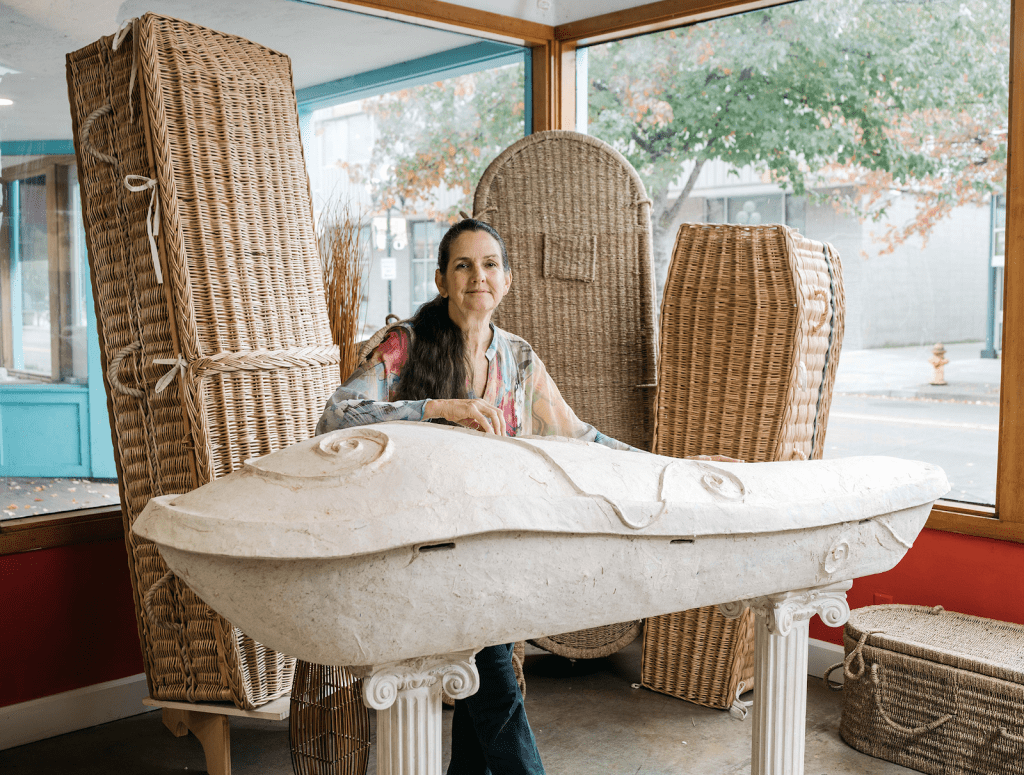
Cynthia Beal, founder and owner of the Natural Burial Co. in Eugene, OR
This part can actually be the most fun and engaging topic to have. The “traditional” funeral is about as traditional as a white wedding. Funerals as television sitcoms and movies show them, have only been “normal” for about the last 100 years. Dying in hospital, shuffled away to a cold fridge until you are dissected and pumped full of chemicals to make you last less than a week, then dumped inside an overly expensive box only to be placed inside a cement vault is all pretty new fashion. Same with the “funeral”, unless you are part of a minority culture, you likely know the funeral and black and somber, with a quiet viewing and some food afterward. Sprinkle in maintaining a safe distance from the corpse, not discussing the death itself, and making sure the kids don’t see too much. All at a very expensive cost of course.
The truth is, our deaths need not be as constrained as our lives sometimes feel. It may seem like death is full of ways to restrict you, and make you spend money, but besides a few key points and specific policies, your death can be as spectacular as your life, or just as comfortable. You can die at home, it’s all right, and you can have as many or as few people there as you like. Your corpse can stay in your home, and you can have your family prepare you. You do not need to be embalmed, and you don’t have a service in a funeral home. Everything can be done in your own home, even with your corpse on full display. Some people even do it in style. On the other hand, natural burials are back. Just have yourself put in a shroud or a natural casket and dig a hole in the ground. Of course for this, there must be special cemeteries that are allowed to do this, but they are out there should you want them. Also, water cremations are a thing, and there are many options nowadays, some of which are ancient and being rediscovered. Keep your mind open and give it the thought it deserves. And it’s best to do it now, and not while you actually see your death approaching you. If you are open to it, this can actually be a fun topic to have with close friends and family.
Our Responsibility to Ourselves and to Others
Finally, I want to revisit one of my original points from the beginning of this writing. What is our responsibility to ourselves and to others when it comes to death? As this could be a whole other extensive topic, I’ll try to keep it to two simple points. One: I feel we are responsible for ourselves to at least respect the remains we leave behind. Two: I feel we are responsible for those around us to respect the situation we leave them when we die.
Even if we can openly converse with our families about death, the topic can usually reach the point of, “if I end up like x, just take me out back and shoot me.” I’ve heard it a lot from friends and family, and even though it’s meant to be funny or a nod to “keep it simple”, life and death with it is always more complicated. We owe it to ourselves to give it more thought. Our lives were lived, our lives were real and raw, and hopefully for many of us, filled with long years of beautiful and tragic memories that deserve to be honored. It is thus our responsibility, that no matter what we believe lies beyond our last moments, that our empty vessels will be cared for with dignity and just a bit of planning.
As for others, if you have the opportunity to be someone’s “death friend”, for a simple term, feel honored. It will likely be one of the hardest but most rewarding things you’ll ever do. Just make sure you are prepared to do it. For most of us, this duty will come to us as our parents die, and expectations that were never understood and never fully developed suddenly come into strong relief, if death planning was never a conversation you had with them. This happened to me with my father, and I was blessed to have an Aunt who helped walk me through the process. She was my “one” without any expectation of it, but it was a true gift. Despite traditional expectations, if you think you can’t hold that space when your parents reach their journey’s end, think about that now and figure who else might be able to take this role. If you are in a minority community and/or are estranged from family, look to your friends, the family you choose, and decide now to have that conversation with them, for yourself and be that for them as well. As our world grows grayer, and more difficult times continue to come, I believe it is our responsibility to hold space for others both in life and death, as best we can.
Practical Resources
The Order of the Good Death, as I’ve discussed quite a bit in this piece, is a substantial resource, very down to earth, and open to all of every walk of life. I swear this article isn’t a long advertisement for them, but they really are one the first and one of the few resources out there for this. They are part of the Death Positive Movement, and in fact, started the movement. Also, they are a great resource if you’ve ever wondered how to make your death “eco-friendly”. They’ve been around for nearly ten years, and will likely direct you in some shape or form to what you need to know, even if they just give you the language. Also, check out Ask a Mortician on YouTube. The Order of the Good Death: Home
Here is a specific link to learn what Advanced Directives are and the difference between this and a Living Will (did you know a living will means nothing in Michigan?), and also the difference between these two and Advanced Care Planning. For Advanced Directives: Advance Directives: Durable Power of Attorney for Health Care
This topic is often state-specific, so make sure to look for laws where you live or expect to be living if you know where you’ll be facing death. This link will get you started: Patients and Caregivers. There is also information here on Advanced Care Planning.
For many of us, money is often the first and the last thing on our minds when it comes to discussing death. Large bouts of anxiety and frustration come about when it’s time to plan a funeral, pay for end of life costs, and decide who is responsible for that. On the other hand, if you fall on the lower end of the socioeconomic ladder, “assets” may seem like a funny word, and you think, “just bury me in the back yard if you have to.” Let me tell you now though, I can 99% guarantee if you are an adult with so much as a State ID, you will likely be surprised by what you find when you sit down to consider what you’ll be leaving behind when you die. If you have any money or any assets whatsoever, even a bank account, you’ll want to make sure all these things are accounted for. Nothing is more overwhelming for a loved one than trying to locate your paperwork, figure out what you own, and what you’ve been doing with your life 300 miles away after you die suddenly and you were considered homeless. Then they still have to pay to take care of your corpse (that may or may not be an actual anecdote). There is a financial trail that you’ll leave behind, and what you want to make sure is that whatever you have, even your empty wallet, isn’t lost from your loved ones should you pass suddenly. How to Prepare Financially for Your Death, No Matter How Young You Are
As I mentioned above, it’s important to learn how to talk about death with your family. Again, Ask a Mortician, Caitlin Doughty helped me out the most here: Ask a Mortician: This Season’s Hottest Trend Is…
For those a bit more local to Michigan, the University of Michigan offers great resources in the medical aspects of death: Care at the End of Life
Update and Plan B
And update, update, update!
Finally, when all is said and done, and you’ve crossed that last T and dotted that last I, and made sure it was all saved in your Google Drive, set yourself some reminders. More than likely, and hopefully, you won’t actually die soon, despite the world on fire, so set yourself a reminder to look these plans over every few years and update them, especially with important life changes, like a new child, change of partner, or loss of a person integral to these plans. You may even want to consider a “Plan B” person, to list “in case of” if you so have someone. Making sure to update these plans, and discussion of worst-case scenarios may actually be the hardest part in all this, but this exercise also helps to keep reality fresh, and the acceptance and growth alive along with it. No pun intended.
I won’t go into specifics regarding death and COVID-19, as the multi-medias are flooded enough with that information right now and it’s ever-evolving. I’ll leave that to the experts over at The Order of the Good Death, who have already done a few excellent pieces on this specific topic already.
What I will say is, during this time of isolation, uncertainty, and fear, thoughts of death come bubbling up in unexpected ways. For some, there is simply too much time to think. However, this also gives us time to grow as humans in new and positive ways. Let’s make “meeting death as a friend” one of them. We may in fact die alone, but we don’t have to feel that way.
When I began this journey, nearly two years ago, I never expected to have a nine-month break, but sometimes that is the way things go. I shall spare the excuses, and just simply say…Well, here I am again. Back in February, I was able to attend Convocation, a pagan-bent convention where many classes and rituals are held for attendees, and there I was sharply reminded of this project to meditate and express the Ogham. Although so much has changed for me personally and otherwise since my last Ogham post, I feel it’s still important to continue this effort. With that said, if my format and tone seem different from previous posts, note this is why. Picking up from where I left off, today we meet nGéadal.
nGeadal
Attributes and Associations
nGeadal. Ngetal. NYEH-DAL. nGeadal of the Reeds and Ferns, of the grasses and greenery of the deep earth. nGeadal is the thirteenth letter of the Ogham alphabet, of the Muine set. nGeadal has a meaning of “the act of wounding”. It may be a verbal noun of “gonid” meaning, ‘wounds, slays’. in which case it is related to Welsh gwanu ‘to pierce, to stab’, which comes from the root *gʷhen- ‘to pierce, to strike’. Its original phonetic value in Primitive Irish was [ɡʷ], the voiced labiovelar. In Old Irish, this phoneme merged with g (gort), and the medieval manuscript tradition assigns it Latin ng [ŋ], hence the unetymological spelling of the letter name with initial n-. In the Kennings, there are three phrases for nGeadal: lúth lego “sustenance of a leech”, étiud midach “raiment of physicians”, and tosach n-échto “beginning of slaying”. With these very interesting meanings, it’s also interesting to point out the pretty equal discovery that nGeadal is associated with either Reeds or Ferns. That is why here I have nGeadal associated with both, or with grasses as a whole. I find it fitting, that while nGeadal is not associated with a tree, it can be associated with grasses on a far larger scale and the great diversity therein.
The specific attributes of nGeadal are resilience, wounds, wounding, pain, ferocity, flow, and practicality. The Reed and the Fern enlighten us to the broader balance of humanity and although nGeadal can seem intimidating, the necessity is also apparent. Bringing us a little out of the realm of the trees, they are no less important to our lives as humans.
Ferns are incredibly prolific and found throughout the world in many forms, particularly shady woodland areas and lowland mountainsides. They bear neither seeds nor flowers, but can give nutrients to humans and animals alike when just shoots. Ferns are also tenacious and not easily removed by any means. As ferns can cover great swathes of acreage they can provide a soft green blanket of protection to the earth below it. Beneath that soft blanket of feathery leaves, Fern plays host to a myriad of small animals. Rodents shuffle between the stems and during the hot summer months snakes freely weave their sinuous, sensuous dances and mating rituals. Fern offers them all protection under its low sweet-scented canopy. Stags cut pathways through expanses of Fern, and the Fern provides much-needed greenery even in places that other plants will not take up.
Reeds are very versatile themselves, used for all manner of crafts and also help keep our precious wetlands alive. The name reed is the most commonly used term that refers to grass-like plants the grow all throughout wetlands but is also referenced to most by-the-water growing plants. Reeds are historically essential to the expansion of culture and civilization. I’m sure most of you have also seen or at least heard of reed thatched roofs, reed boats, reed houses, and even musical instruments made of reeds. Even today these traditions are kept alive in many places in the world. In my part of the world, reeds are not used so often in a practical sense but still adorn many households and gardens in some capacity.
Common Ferns
The Contract
Sometimes it is not the high tree above us which gives us pause, but the humble shoots and curling green leaves of the ground beneath our feet. In the grasses, in the reeds and ferns, we view another angle to our world. At times this means pain and blood and tears. At times this means causing wounds and receiving them in turn. These actions are no less vital to our lives and love and comfort. Sometimes, they are even more necessary. In order to thrive and find harmony within our relationships, in our work, in our paths, we must grow and we must feel the pain and see the hurt of the world around us. In accepting this within ourselves, we are truly alive. nGeadal tells us we have pain within us, or that we are hurt in some way, he may also tell us that we may be causing pain, or that we must find a practical or resilient solution to the hurt we find. nGeadal tells us to look more closely at the wounds we bear, to find a way through them, and not shy from them.
Well, it certainly has been a minute since I’ve written here. Life has had a way of keeping me mentally strained for a good while. And while it may be my first post in probably a year, I’m hitting the ground running with quite a weighted topic. While nearly all the information here is very personal, I felt called to share it. This may not be a spiritual post as this blog is intended, but this definitely speaks to and provides a part of my foundation in my spiritual work, and believe this mental breakthrough will open a lot of windows in my soul and is what I hope another leg in my journey of recovery and spiritual learning. True friendship is so precious and rare and has always been hard-fought for someone like me. Every person in my life has always been an important part of the tapestry and connection to my soul, and so to come to the realization that I did about the person I speak about below, is incredibly devastating, even after all that happened and all this time. To heal is a long and difficult journey, to heal spiritually is even harder. This is some difficult shadow work, but I do hope it guides me to the next step.
In the Summer of 2002, I moved to Oklahoma. I was an uprooted girl of some 14 years, entering a highschool in a world I knew nothing of. I had no friends or family around me, besides my mother, and already I knew my home situation was less than ideal. Entering high school, a difficult enough time for any young person, I was quickly met, and found myself attached to, another young girl whom I’ll call Heather. Heather was bright, slender, blonde, and came from a family with more than a little money. She was a bit popular and was generally nice. She welcomed me into the school and helped me meet the small class of Freshman entering that year. The highschool was very rural, and in the end that class had a graduating count of twelve, just to give a little scale. On the other end was me, new to not only the school system, but the state, dark brown-haired, not slender, and already possessed of an intense anxiety disorder that would continue to go undiagnosed for years along with other mental issues. Thus, was the basis of a perfect storm for a fourteen year emotionally abusive and toxic “friendship”.
Today, in what is now early 2020, I was exploring a new YouTube channel, and came across a video of a man discussing how he got through the trauma of leaving a long and abusive relationship with a woman. While this man talked, certain aspects of what he was describing started jogging memories for me. Memories of someone I had “ghosted” three years prior and had written a letter explaining why I would never talk to them again. The man described a lack of respect for interests and hobbies, not fully listening, couldn’t trust her, very much needed taking care of (money, chores, planning), etc, and the love was a one-sided affair of manipulation and blackmail. As he went on it became more difficult to breathe, I found myself looking away, and a dull ache grew in my stomach, all making me aware of an oncoming panic attack. Something finally clicked in my brain at that moment. Something I avoided before even though I believe it had lurked through my internal hallways for a long while, making low growls every time I thought…of…her. It shone through those hallways then like a blinding light, no longer able to be ignored, suppressed, or rationalized away. I had been in an abusive relationship. I had been the victim of emotional abuse for nearly fourteen years, and only through the help of true friends and supportive loved ones, and a distance of a 1000 miles had I been able to leave it.
At this point, it may sound like I was in an abusive romantic relationship with a woman, and in some ways it often felt like I was, just without the benefits. In fact, this was a friendship. We never lived together, thank goodness, we never were romantically involved (she was straight-cis), and we each pursued our own individual goals during our long relationship. It may be hard to wrap one’s mind around, as we often hear of romantic or familial abusive relationships, but one can, in fact, be abused in our friendships. It makes sense when you think about it, but this is something rarely depicted in our media, rarely discussed, and even harder to detect, as we often don’t live with these people. Even on the National Domestic Violence Hotline Website doesn’t list Abusive Friendships in its resources. To be fair, abusive friendships don’t often lead to physical violence or as deep a harm, but looking at my experience and even the experience of others, it’s still significant. Often they are labeled “toxic friendships”, which is a huge part of it, but I’ve come to believe these types of relationships should be included under the truest term, abusive relationships. This term brings a weight to the situation that “toxic” doesn’t really, and opens people eyes a bit more to what is happening. Until this point, I personally brushed what had been happening aside, and rationalized, and even defended the situation of our friendship (my goodness, the gaslighting was real), because how could it be abusive? This wasn’t a family member, I had no romantic ties to this person, I didn’t even live with this person, how could it be “that bad”?
Well, let me tell you. Once I really grasped what those fourteen years had been, I could sit down and start to break down all the signs and the trauma that I ended up with. The sad part being, I can’t even recall all of it, as apparently I suppressed a lot of what happened in Oklahoma. The even sadder part being is that the start of this friendship coincided with another four years of emotional abuse I suffered both directly and secondhand in my own home from my step-father. Holy shit, I hated high school. That being said, I’ve suppressed a lot of memories of that time, but given what I do know, this would end up being a rather long post so it’s probably for the best. Anyway, the friendship itself started out pretty normal, and I didn’t even hang out with her so much in the beginning. By the time I switched schools in Junior year, however, we were calling each other best friends. We even made time to take prom photos together our senior year as we went to separate proms. I believe there was a few red flags in those four years, like getting angry with me for not covering for her when she snuck out of her house one night after her parents divorced. A situation she didn’t inform me of or ask me to cover for her, and thus I thought she was missing myself, but no, it was my fault she got in trouble, although I have no idea how I would have covered for her from the two adults in my house who would have known if someone was there or not. There was a lot of that after her parents divorced. I can see now that was the beginning of several issues for her, and a lot of what became the root of her future actions, but as much as I can sympathize I can no longer make it an excuse. All abusers usually have trauma of one sort or another, but so do we, their victims, and yet most of the time we can keep ourselves from traumatizing others.
Once in college, I had moved back home to Michigan for two years, started a new life, made my own mistakes, even created a little more drama for myself as I dealt with the aftermath of my home abuse. I’ve discussed this all before in my Journey blog from last year. During this time, I didn’t connect much with Heather, but in the times I did she did make it clear I was failing to be a good friend, something I didn’t realize she was doing, and often felt shame for. She even managed to blame me for failing a class, because she asked for unsolicited advice from my mother who was an Administrative Manager, not a professor, but she managed to blame me for it, all while I dealt with the death of my grandfather no less. When I returned to Oklahoma in 2009, when the recession hit, I did spend more time with her and for the next three years, that relationship was more and more tense. Once, after I won a Scholarship and an Award for my paper on Indigenous Assimilation, and hers did not, she managed to find every way that my paper wasn’t worthy of winning, and hers only lost because of prejudice. I, of course, defended her actions to my mother and boyfriend (now husband) who of course found this distasteful. As her life became less and less what she envisioned for herself she took it out on those around her, namely me. Again, I don’t think I realized what she was doing. I think in some ways it was all the same to me, from what I’ve dealt with elsewhere in my life. By the time she graduated, we had both found ourselves single, her fiance had left her, she didn’t have the job she wanted and wasn’t being accepted into grad school, and her financial situation was lessening as her mother no longer doled out for her every whim. I was the one to give emotional labor in these instances, a role I was very familiar with in my life, and thus took each round with a mild headache.
Finally in, 2011, I managed to return to Michigan again, rekindled my relationship with my boyfriend, soon to be fiance, found a great job, and even started to get my health back, while Heather’s life just seemed to spiral worse and worse. At one point even getting arrested in a possible prostitution ring. Again, why did I still call her such a close friend? The distance did help, however, she still felt like a clingy girlfriend that just wouldn’t let go. The next five years was spent setting up phone schedules, dealing with her emotional labor, find a way to keep up on her needs, and being disappointed about visits, being told I abandoned her, questioned about considering her as a best friend, and finally during my wedding, being told I was a bridezilla, and being questioned about every aspect of what I asked of my bridesmaids, despite her almost demanding she be one. This was 2015, and the beginning of the end. The next year was a continuous roller coaster in my own life, that by the end I was beginning to gain the weight back I had spent so much time losing, having trouble at work, and several family members and other friends in various states of issues. By November of 2016, I finally, FINALLY, couldn’t take her drama anymore. The last straw came when, once again, we were rescheduling a phone call and couldn’t find the time. Her last message was asking for the call to be a Sunday morning at 8am. I didn’t even reply. That may not seem significant, but to what had always gone on with her, it was the end. The next day, I began a letter to her that I finished a couple of days later and mailed off. In the meantime, I began blocking her on all social media, my phone, and telling mutual friends we no longer spoke. It was a huge decision for me, but honestly, at the time I didn’t really comprehend the full weight. I was just “losing a friend”, who really wasn’t a friend, and that’s hard enough, but everyone goes through that at some point. We took different paths and had different views on life. That’s completely normal, so I rationalized.
Over the next three years my life started a backward slide, work was difficult, I was a my high weight again, I had lost my strength, and started using a cane. I began having several medical issues and lost several family members. I started having a slight addiction problem. These issues started before I ghosted Heather, but I think subconsciously, cutting her out of my life had a much larger tearing effect than I ever thought, and I feel, this was because in truth, that relationship was just as emotionally abusive as one can have. Unfortunately, although there was a lot of relief and good that came from cutting her out, I think because I didn’t reconcile what exactly that toxicity did to me, I took away a lot of shame and guilt from leaving that relationship, internalized it, and it exacerbated all my other issues, particularly my body weight and addiction, which Heather always had a comment on.
So now, today, three years on, I find myself having a full realization that friendships too, can be abusive and that I was in one, for a very long time. I’m writing about this, for myself, to manage my thoughts about it, to accept its reality, which in the back of my mind I’m still trying to rationalize away, and for others of course, because as with so many things about abuse, manipulation, and gender, it’s just not talked about enough. Women abuse, friends abuse, trauma and abuse leads to other trauma and abuse, and we all need to consider that in our lives and in our spirits.
Well, it’s certainly been a fair minute since my last post. I’m trying not to let guilt or urgency influence my continued writing and still take the time I need to develop my post. Despite these being shorter workings, I simply didn’t have the time or energy to devote to them properly over the last month or two. To be fair, I was diligently working on another major writing project, so at least it was productive time away. Finally, I’ve had the time and mental capacity to sit down with Ruis and acknowledge their facets. I’ve already sensed the feeling that Ruis is a bit of a roller coaster ride on the scale of actions and emotions they touch so let’s see what we can do with that.
Attributes and Associations
Ruis. RWEESH. ROO-ESH. Ruis means Elder Tree. Ruis is the fifteenth letter of the Ogham alphabet, of the Muine set. Ruis is derived from ruise “red”. Its Proto-Indo-European root was h₁reudʰ- ‘red’. Its phonetic value is r. The attributes of Ruis are regret, retribution, maturity, abundance, transition, success, consecration, and good fortune. The Elder is also strongly connected with Goddess spirituality, and the workings of the Fae. Ruis is beholden to all elements and finds attunement with all forest spirits. Ruis is also associated with the Winter Solstice.
Elder trees are known in the scientific community as Sambucus. The various species are commonly called elder or elderberry. The various species are commonly called elder or elderberry. The genus was formerly placed in the honeysuckle family, Caprifoliaceae, but was reclassified as Adoxaceae due to genetic and morphological comparisons to plants in the genus Adoxa. They bear large clusters of small white or cream-colored flowers in late spring; these are followed by clusters of small black, blue-black, or red berries (rarely yellow or white). Native species of elder often support populations of butterfly and bird species. Elder trees grow commonly in Britain and Ireland but also flourish across the northern hemisphere.
Elder wood is often used to make flutes and other musical devices, and the flowers and berries make delicious wines, cordials, and meads. Elderberry fruit or flowers have also been used as dietary supplements for minor illnesses such as flu, colds, constipation, and other conditions, often served as a tea, extract, or in a capsule. Folklore says leaving the berries to ripen upon the tree for the blackbird to eat, they will bring echoes in their songs of the Otherworld. Like blackbirds, Ruis guards the gateways to the Otherworld.
The Contract
Ruis of the Elder Tree. Ruis of the Red. You sit with me as I am scarred and worn. I have many years to go but many winters have passed already, difficult and painful. I feel an age upon me that seems beyond my cumulative years. Ruis grips my shoulder, to face this regret to feel my own retribution. Do I let it in? Ruis the red whirlwind, I feel you as sharply as my own sweat in my eyes from the labors of my own body. Maturity grows upon me, like the ripe berries that you bear and I enjoy to consume. Red blooming before my eyes, of all shades of understanding, it cannot be missed. It is your call to action.
Sounding in the deep of my red blood, sounding out in notes of drums and flutes of rushing winds, it crescendos around me and hails the oncoming storm of life. A music to behold, of battle and of passion. This is not a normal calling, this is to be understood as rare and uncommon opportunity, balance your feet, learn the dance, and seek the perfect rhythm, lest it break and all lays fallen. Ruis will tell you that should you break the rhythm, not all is lost, but it grows harder each time it must be mended. Take the rejuvenation in seriousness.
I stand up from cracked and dirty floor. I shake and stumble upon my sore legs. Awareness of my experience flows through me, another ending has come. Perhaps to happen again someday, but for now, I close this portal, and call for Ruis to guide me through this new armageddon, this ending of a cycle long seen for. I shall embrace this chaos and walk to a new dawn.
I am very excited to this journey’s ogham. Willows hold a very special place in my heart, and I definitely greeted Saille with open arms when she came forth. On my property stands a very very old willow tree, whom we fondly call Old Man Willow. When we arrived at this house to look at it, Old Man Willow was the first being we saw, along with all the other very old trees on the property. Of course, this comes with its own issues in that maintenance was required, and within the first year we had to do some major trimming, but Old Man Willow lives on, albeit a bit more preened. He’s presided over this house likely since it was built in 1940, and if all goes well, will be there long after we are gone. He gives a comforting presence to our home and is paired with what was likely another willow in the front yard that was cut down some time before we moved in. There is spiritual work there to be done, but in the meantime I am doing my best to establish a good relationship with willow, and thus have a good start with my meeting with Saille.
Saille
Attributes and Associations
Sail. Saille. SAHL-Yuh. Saille means Willow. Saille is a name related to the Welsh helyg-en and latin salix. Its proto-indo-european root was sal, and it’s phonetic value is s. In the medieval kennings, the verses associated with saille are: li ambi or “pallor of the lifeless one” in Morann mic Moin, luth bech or “sustenance of bees” in Mac ind Oc, and tosach mela or “beginning of honey” in Culainn. Attributes of Saille are birth, connections, enchantment, fertility, flexibility, healing, knowledge, relationships, and wishes. The deity I find most patrons Saille is Ishtar and finds elements in both fire and water.
Willows are notoriously hardy trees, and have a great love of water. There are over 400 different types of willows and all have abundant watery bark sap, which is heavily charged with salicylic acid, soft, usually pliant, tough wood, slender branches, and large, fibrous, often stoloniferous roots. The roots are remarkable for their toughness, size, and tenacity to live, and roots readily sprout from aerial parts of the plant. Almost all willows take root very readily from cuttings or where broken branches lie on the ground. Perhaps to emphasize their tenacity to life, willows have grown from heat laden tropics to near arctic zones all across the earth. Due to Willow’s apparent peaceful, serene nature, it is no surprise that its spiritual attributes are also that of peace and serenity. Its presence brings us comfort and joy, which allows harmony and balance to those who seek its influence in their meditations, and inspiration into their hearts and minds.
Saille by OneTwistedPixie
The Contract
Saille dances and swirls about me. I sit upon the floor, eyes closed, and Saille imbues soft light upon my eyelids. She understands what my inner being is missing. She speaks through my land, and whispers wonders through Old Man Willow. May I find peace within knowing they watch over me and mine. Timelessness exists in this space with Saille. I can exist here in a moment of calm and healing. Here, I can find balance, swim in a sea of perfect waters, as they tell me where to find what I need. I can return this world with this balance restored, and find flexibility in perspective of the world, and growth in my relationships from a place of resilience and adaptation.
I’ve finally arrived at Ogham Ten!!! Honestly I’m surprised I’ve gotten this far, but here I am again with La Croix in one hand and goldfish in the other. I’m working on this one a little sooner than usual as I’ll be out of town and not sure I’ll get to it on time. We’ll see how this goes. Lately, I’ve had a lot more writing projects, and keeping up with them has been a journey in itself. Anyway today we meet Luis. No not you Louis, stay in your corner.
Attributes and Associations
Luis. Luise. LOO-Shuh or LWEE. Luis means Rowan. Luis is derived either from luise “flame” or from lus “herb”. Its Proto-Indo-European root was either leuk- ‘to shine’ or *leudh- ‘to grow’. Its phonetic value is l. The Auraicept na n-Éces glosses the name as cairtheand “mountain-ash”, “rowan”. In the Bríatharogam the verses associated with Luis are: lí súla – “lustre of the eye”, carae cethrae – “friend of cattle” and lúth cethrae – “sustenance of cattle”. Here we have another ogham, or fiodh (FIH-yuth) the individual letter (I’m learning as i go along here) that brings information on protection. Specifically, defence, protection, and sanctuary. Rowan wood is often used in wards against evil, and signals that appropriate measures have been taken for safe-keeping.
Rowan itself, is a fast growing tree that takes root in high elevations and lively valleys. In the autumn it bears edible fruit for all creatures, and although considered a smaller tree, it can grow to heights of fifty feet in its elder years. Rowan wood has many similarities with hazel wood. Both are heart woods with a similar texture and coloring once the bark is removed, both need the same amount of seasoning time, both feel the same when carving and sanding.There are many practical uses for Rowan, including bow-making, tool handles and eating vessels such as bowls and plates. Rowan also has many spiritual uses, although most abundantly for protection magick. Some of these uses and meanings are blessings, centering, dedication, expression, grounding, imagination, insight, luck, music, poetry, quickening, and strength. Brigid bears a strong patronage with Luis, and elves and dragons encircle.
The Contract
Luis comes and places her hand upon my brow. Everything will be alright. She has always been there, and will always be there, as any companion of Brigid would be. She shows us that we should be conscious of the hurt and pain out in the world, but we can prepare for it, and look for ways in which Luis is protecting us. We should thus take the time to understand the danger that is lurking around us, and take steps to nullify it with the resources we have, while we have time. Rowan is planted in sacred sites, and placed above doorways for protection. Meet openly with Luis, reestablish your defenses, and remain calm, and carry on.







 A Mindful Repose